It is the conversation nobody wants to have, and every couple ends up having. One of you earns £2,400 a month, the other £1,600. The rent is £1,000. Do you halve it, or split it in proportion to what you earn? There is no universal answer, but there is a calculation, there are consequences, and there are numbers on what people actually do. We make Banana Split, an expense-splitting app, and we looked at 75,000 two-person groups tracked in it since 2011.
The short answer. A straight half works when the two incomes are close, or when the shared expenses are small next to what each of you has left. As soon as the gap runs into hundreds and the rent weighs heavily, 50/50 stops splitting the expense and starts splitting the effort unevenly: in the example above it leaves £1,100 to one of you and £1,900 to the other. The proportional share takes one line, your income divided by the two incomes added together, and gives 60 % and 40 % here, so £600 and £400 of rent. And in practice almost nobody does it: in our two-person groups, 98.7 % of expenses are split equally.
What two-person groups actually do
Our data does not say who is a couple and who shares a flat with a friend, so we will say two-person groups. But it is the most common case of all: 42 % of the groups tracked in the app have exactly two people, and they account for 54 % of all expenses logged. They are also the groups that last: a median of 15 expenses against 13, a median life of 9 days against 5, and 21 % of them live longer than a month, against 13.5 % of all groups.
Two numbers contradict each other, and that contradiction is the whole subject of this article.
- 98.7 % of their expenses are split equally. Only 8 % of two-person groups have ever used an uneven split, even once.
- In one two-person group out of two, one person fronts more than 60 % of the money. The median share advanced by the bigger payer is 60 %, a quarter of groups have someone above 75 %, and in 5 % of cases one person pays for everything.
In other words: people split evenly, but they do not pay evenly. The difference is settled later by transfer, or never settled at all. We gave that imbalance a whole article, always the one who pays.
The proportional split, in three lines
It needs no spreadsheet. For each person:
- Add the two net incomes. 2,400 + 1,600 = 4,000.
- Divide your income by that total. 2,400 / 4,000 = 0.6, so 60 %. And 1,600 / 4,000 = 0.4, so 40 %.
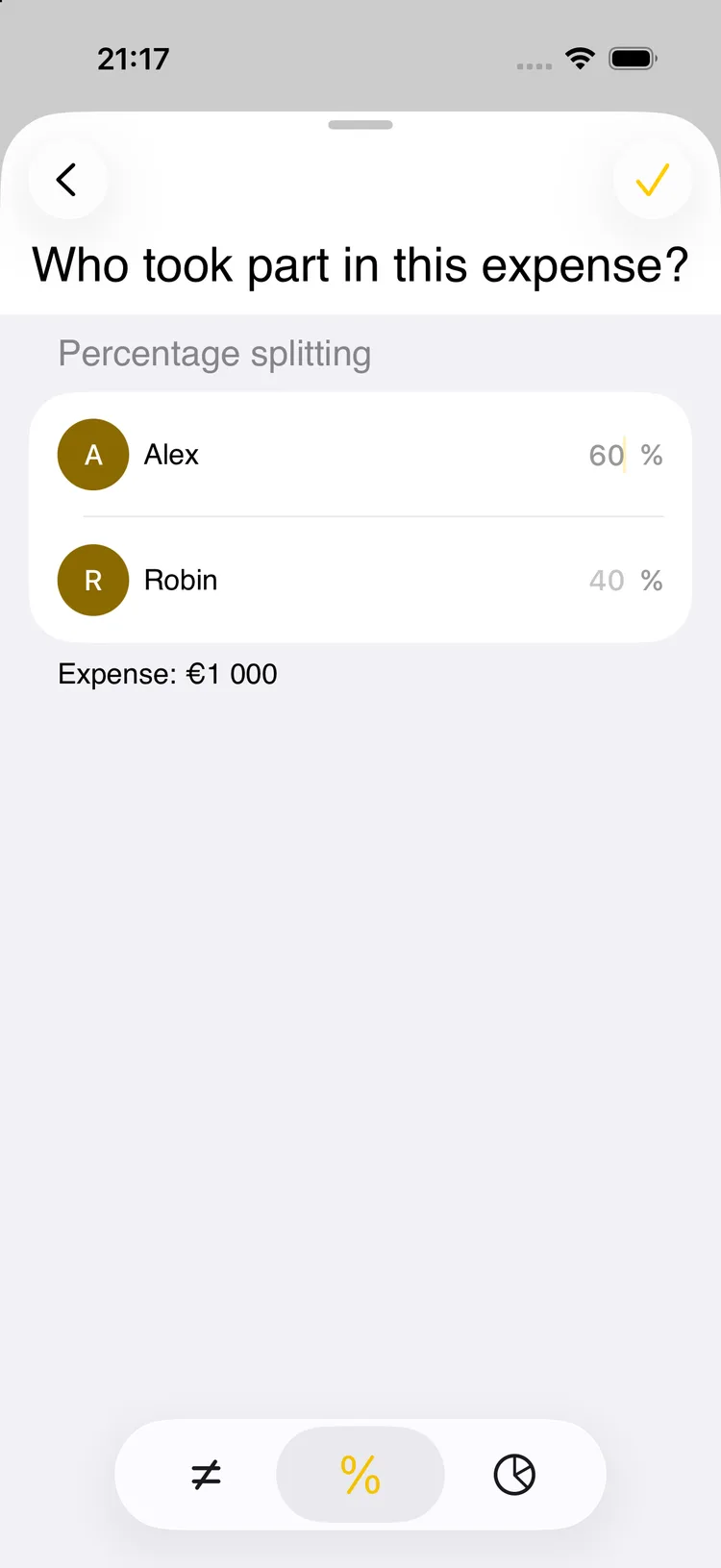
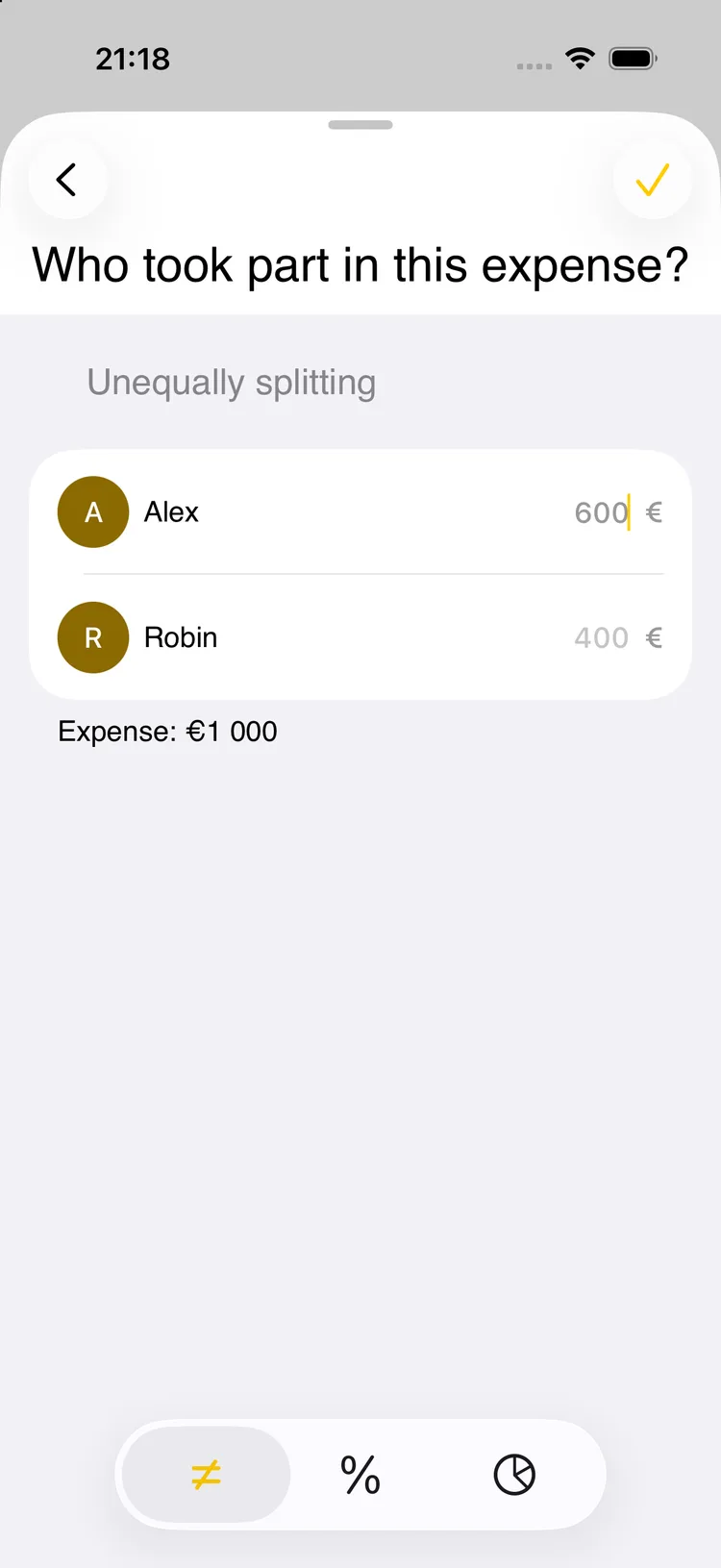
- Apply that percentage to every shared expense. On £1,000 of rent: £600 and £400.
The result is not neutral. At 50/50 each pays £500, leaving £1,900 to the first and £1,100 to the second. Proportionally, it leaves £1,800 and £1,200. The expense moved by £100; the standard of living moved by much more.
Two variants exist, and both hold up:
- Proportional to disposable income. Take out strictly personal commitments first, a car loan, maintenance payments, a student loan, then work out the percentages on what is left. Fairer, and more work to keep current.
- Capped proportional. Apply the proportion to rent and bills, which are the big lines, and keep 50/50 for groceries and nights out. This is the compromise most couples who write to us settle on, because it avoids recalculating a share on a bag of pasta.
In our two-person groups, what share of expenses is split equally?
Across 2 million expenses logged in two-person groups, 98.7 % are split equally, and only 8 % of those groups have ever used an uneven split.
When 50/50 is still right
Splitting proportionally is not a virtue in itself. The equal split keeps three advantages.
It is instant. No discussion about how much anyone earns, no recalculation when someone changes job, no share to update. On expenses that land every day, simplicity often wins.
It makes nobody accountable for their salary. Saying what you earn exposes you. Plenty of newer couples prefer strict equality because it protects each person’s independence. That is not a detail: in France, 64 % of couples pool their income completely, 18 % partly and 18 % keep it separate, and complete pooling covers only 31 % of couples together for less than five years, against 80 % of those together for twenty years or more. How a couple splits follows the age of the relationship, not morality.
It suits a small gap. If the two incomes sit within a couple of hundred, the proportional split moves a few pounds and complicates life for nothing.
When 50/50 becomes unfair
An income gap inside a couple is not an exception, it is the statistical norm. In the European Union, the gender pay gap stood at 11.1 % in 2024, ranging from -0.8 % in Luxembourg to 18.8 % in Estonia. Part-time work, parental leave and sector differences widen the real gap well beyond that 11 %.
Three signals say it is time to go proportional:
- Rent takes more than 30 % of the lower income. The fixed share then eats everything that person has left.
- One of you can never say yes. If a weekend away, a restaurant or a present is systematically a trade-off for one person only, the equal split has stopped being equal.
- The gap is over 30 %. Below that, going proportional changes little. Above it, it changes daily life.
The joint account, the third way
Plenty of couples do not split expenses at all: they feed a pot. Each pays in an amount, proportional or not, and every shared expense comes out of that account. It is tidy, but it does not remove the calculation, it moves it: you still have to decide how much each person pays in, which is exactly the same question.
The strength of a pot is that it makes spending invisible day to day. Its weakness is that it makes the imbalance invisible too: nobody can see who paid for what, or what each person actually used. If you want to keep a record, the app can track both, the pot and the individual expenses, with an individual view that shows only your share.
How to set it up once and forget it
Three settings are enough to hold a proportional split without ever redoing the maths.
- Set the percentages once. The custom split takes equal shares, exact amounts, percentages or shares. 60 / 40 is one slider, once.
- Schedule the lines that repeat. Rent, electricity, broadband: recurring expenses create themselves every month, with their split attached.
- Watch your share, not the total. The individual view shows what each expense costs you, your total and your balance. A £50 dinner becomes £30 when it is split 60/40, and that is the figure your budget cares about.
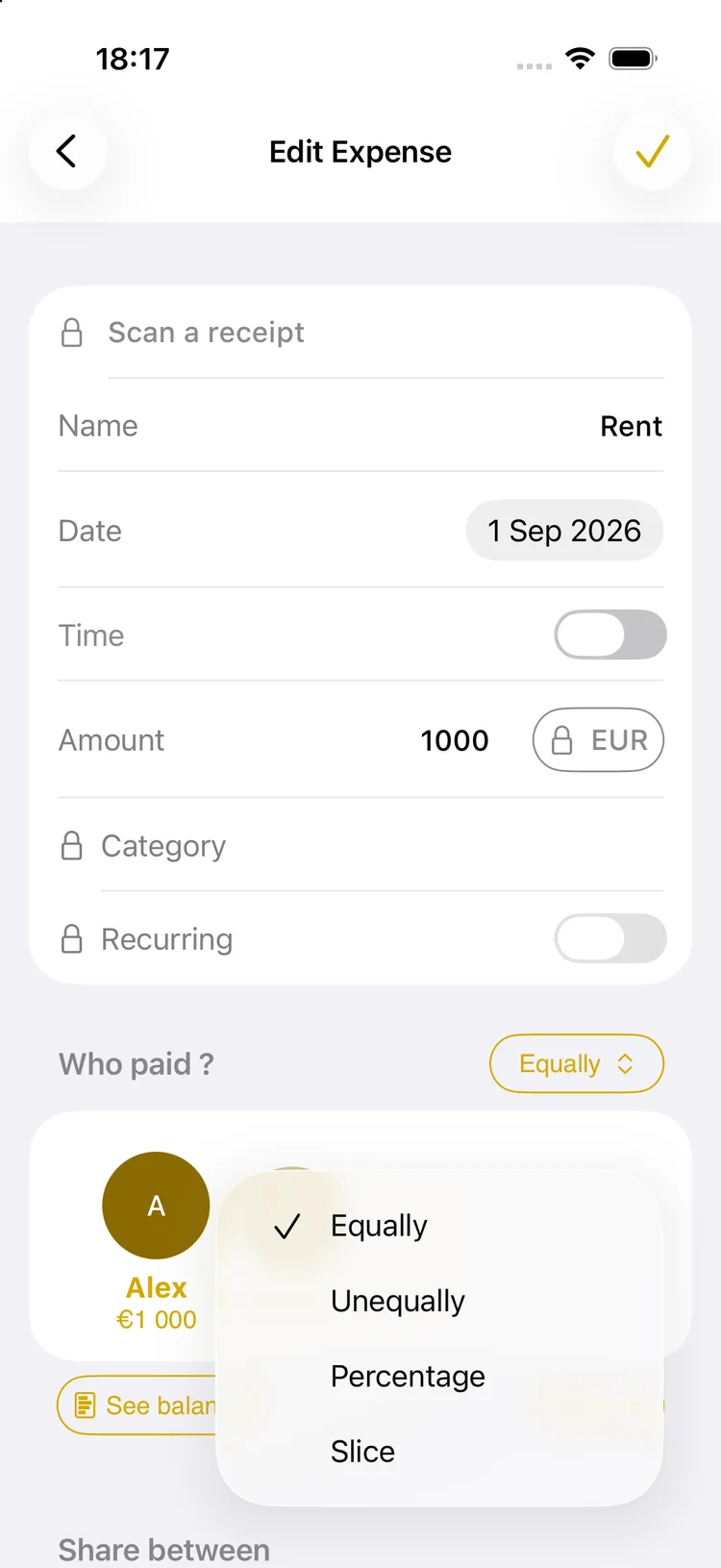
And if you would rather stay at 50/50 but stop the same person always fronting the money, our article on who owes what to whom explains how a group settles in the fewest possible transfers.
What we would do
For a couple with an income gap under 20 %: 50/50 on everything, settled once a month. Simplicity is worth more than being right to the penny.
Above that: proportional on rent, bills and holidays, which are the lines that hurt, and 50/50 on the rest. It is set once in the app and only reopened when a salary changes.
Either way, log expenses as they happen. Our two-person groups run up a median of €878 of shared spending before they settle, and nobody remembers €878 of groceries three weeks later. Download Banana Split and create the group before the next rent day.
Where the numbers come from
The in-house figures come from 179,000 groups tracked in Banana Split between 2011 and April 2026, of which 75,931 two-person groups and 2 million expenses, each group with at least two members and five expenses, reimbursements excluded. The data is aggregated and anonymous. Two limits we own: the app does not know whether a two-person group is a couple, a flatshare or two colleagues, so we say two-person groups; and money figures are computed only on groups kept entirely in one currency, since the database mixes them. The external sources are Insee and Eurostat, linked in the text and read on 23 September 2026.