Dinner at a crêperie in Paris, five of us, the bill lands at €120. Someone does the arithmetic out loud: twenty-four each. My mother had a galette and a cider salad. I had the most expensive galette on the menu, a Breizh cola and a caramel crêpe. We paid the same, and nobody objected, because objecting is worse than losing seven euros.
The short answer. Photograph the receipt, let the app read the lines, then tap the people who had each item. The shares are worked out to the cent and it takes less time than the argument would. On the bill below, the equal share was €24 and the real shares ran from €16.60 to €33.20.
Why dividing a restaurant bill equally is unfair
Here is the actual receipt, with who ordered what and what each person really owed.
| Bro | Dad | Me | Mum | Sis | |
|---|---|---|---|---|---|
| Galette | Complète chorizo, €14.80 | Vendangeur, €17.50 | Artichaut, €19.50 | €12.80 | Confiture, €7.50 |
| Drinks, dessert | Bolée, €5.80 | Bolée €5.80, caramel €7.20 | Breizh cola €6.50, caramel €7.20 | Cider salad, €3.80 | Cider salad €3.80, chocolat €7.80 |
| Real share | €20.60 | €30.50 | €33.20 | €16.60 | €19.10 |
| Equal share | €24.00 | €24.00 | €24.00 | €24.00 | €24.00 |
| Difference | -€3.40 | +€6.50 | +€9.20 | -€7.40 | -€4.90 |
The spread between the largest and the smallest appetite is €16.60, on a €120 bill. Splitting equally moves €9.20 from the people who ate least to the person who ate most, and that person was me. An equal split is not neutral. It is a transfer, always in the same direction, invisible because the number it produces looks tidy.
How to split a bill by item, step by step
Three taps and a photo, in Banana Split.
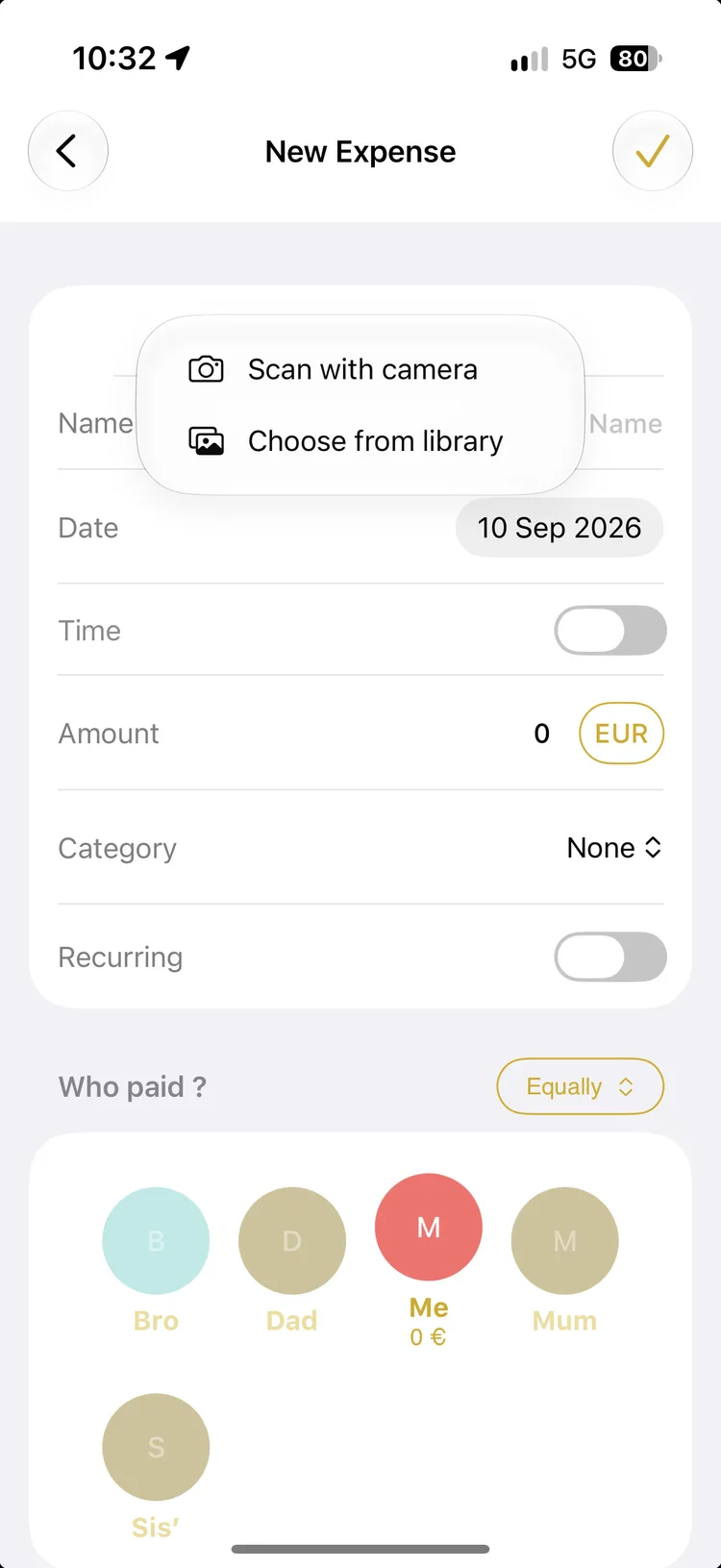
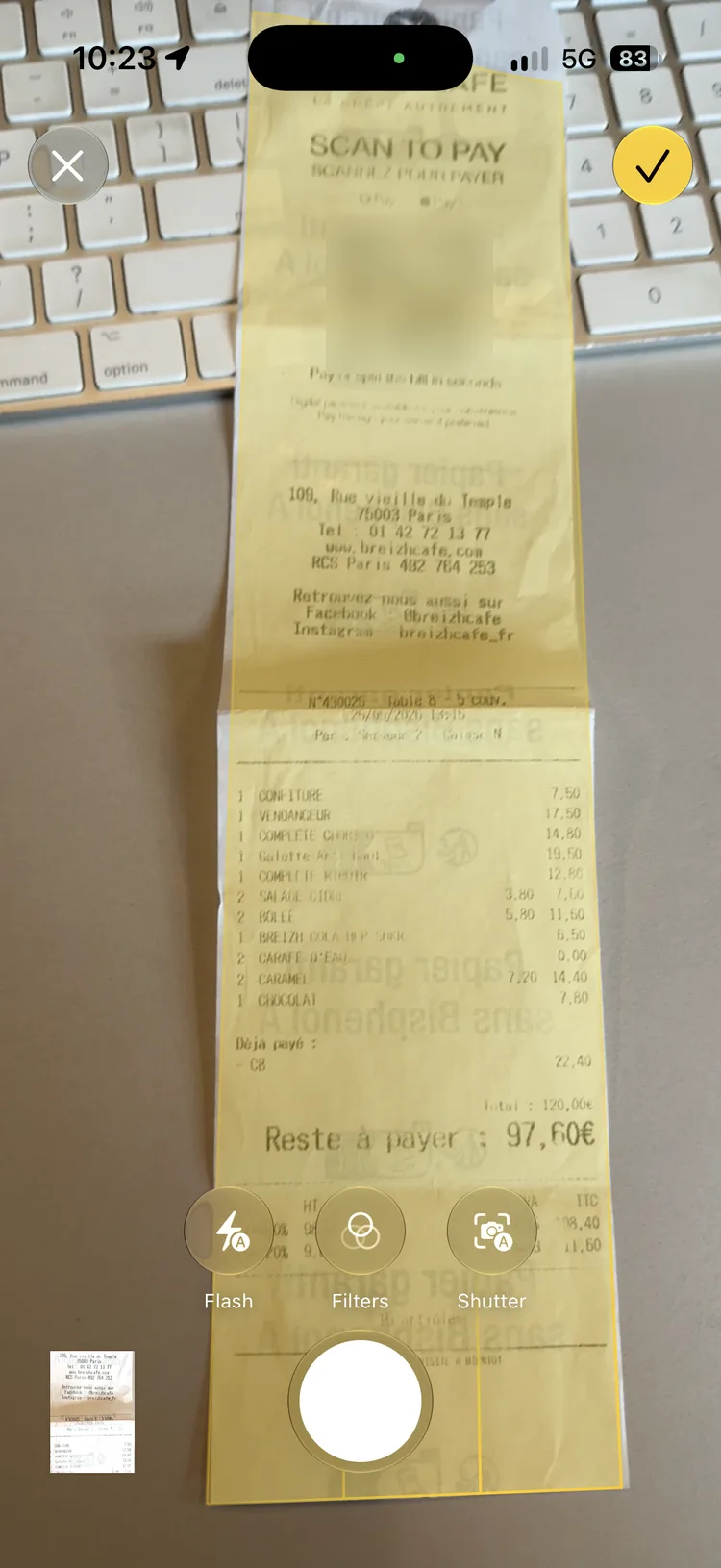
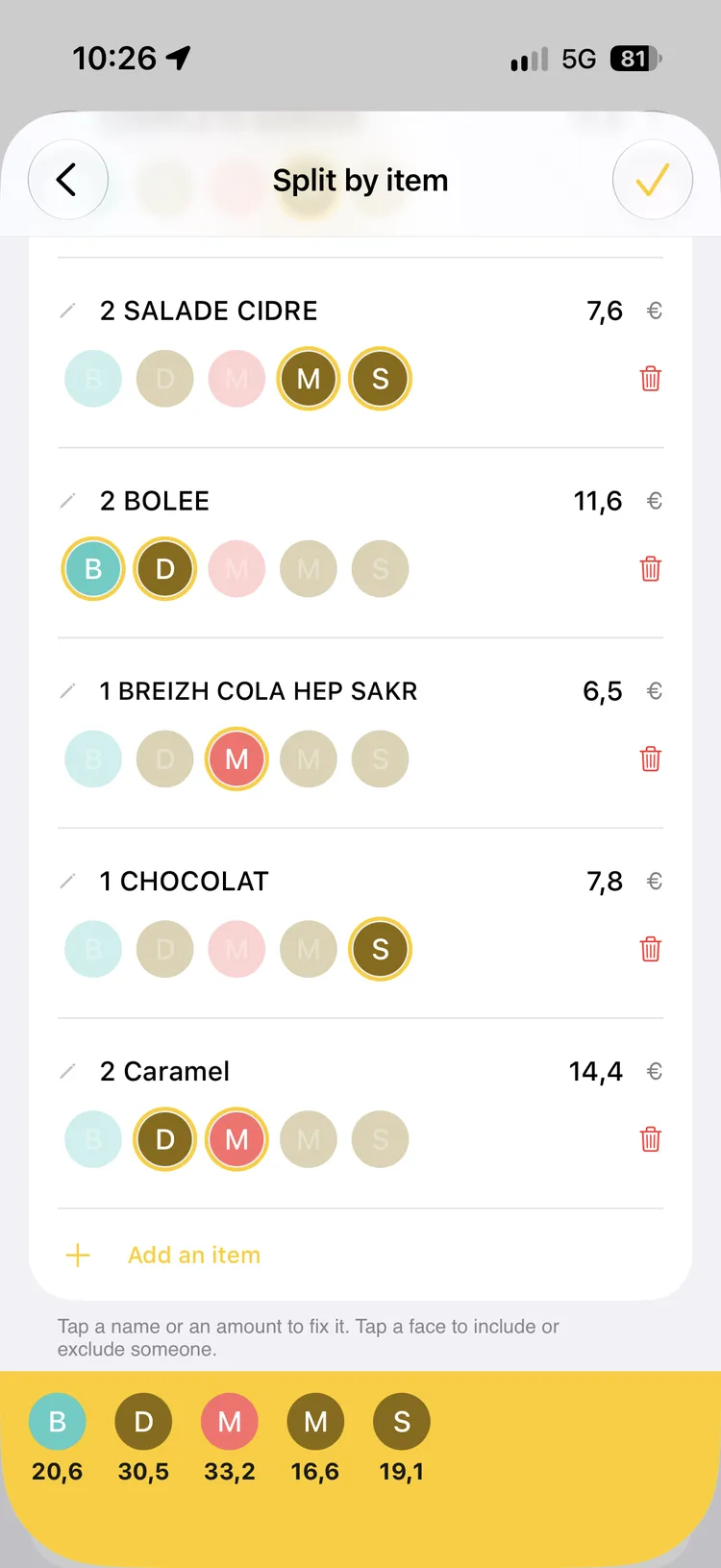
The third screen is the one that matters. Every line comes back with its own price and carries the five participants as initials. Tap a face to include somebody, tap again to exclude them. Two people shared the bolées, so both are lit on that line and the €11.60 splits in half.
The totals in the yellow bar are the numbers the app will save. Preview and save go through the same calculation, down to the cent, which is why the five shares add up to exactly €120.00 and not €119.99.
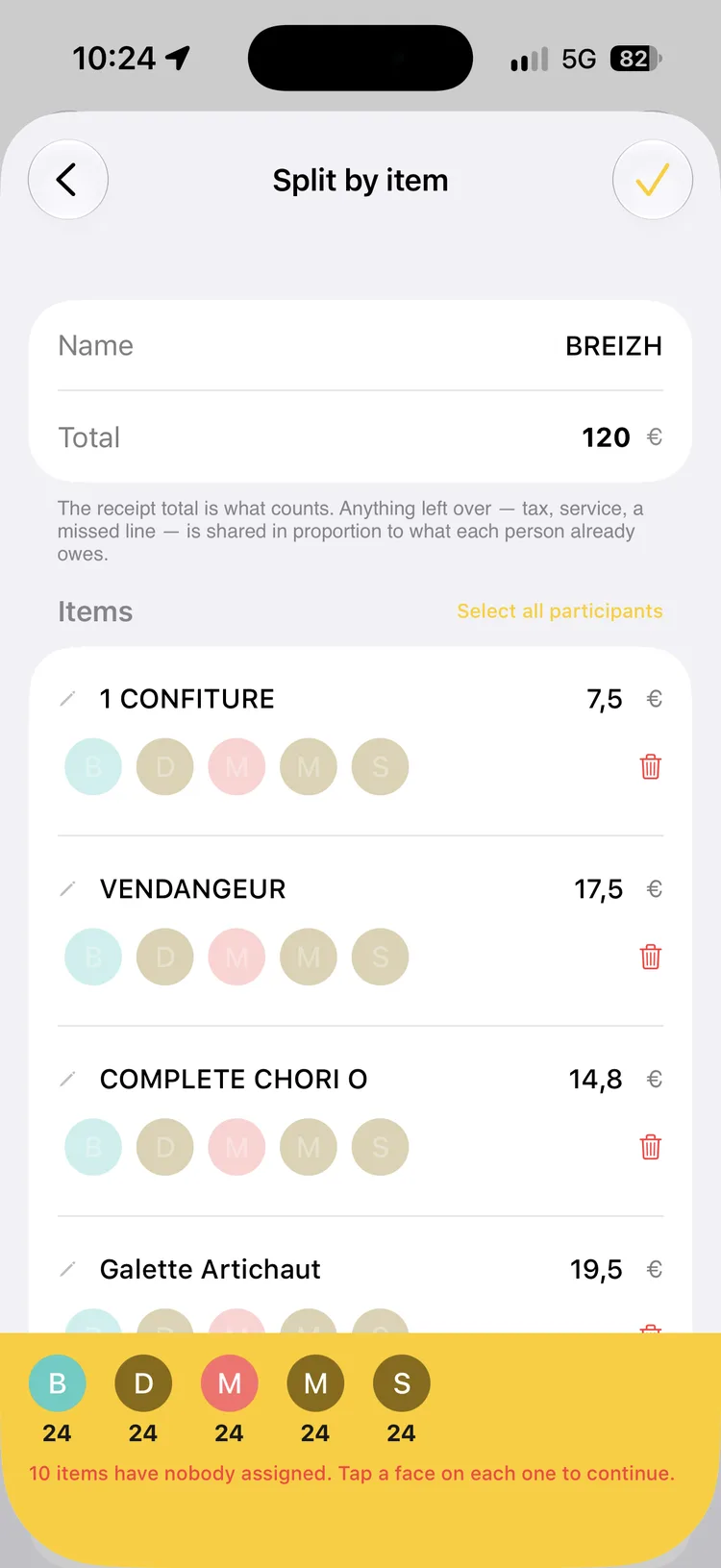
Before you assign anything, the app splits equally, which is the honest default:
This is not a full audit of the meal. Separate the two bottles of wine that three people drank, leave the rest shared, done. Our split types work the same way, by exact amounts, percentages or shares.
What happens when the scan gets a line wrong
It will get a line wrong. Here it read COMPLETE CHORI O instead of COMPLETE CHORIZO, because the till printed over a watermark. That costs nothing: the label is decoration, only the amounts drive the split, and the amounts came back exact. When the reading is wrong you tap the label or the price and fix it, delete a line, or add one the scan missed.
The rule underneath is printed on the screen: the receipt total is what counts. Whatever the assigned lines leave over, service, tax, a skipped line, is spread in proportion to what each person already owes. A missed €4 dessert neither vanishes nor lands on one person.
Does the receipt photo leave your phone?
No. The reading happens on the phone, through Apple’s Vision framework on iPhone and Google’s ML Kit on Android. Google’s own documentation is explicit: “ML Kit’s processing happens on-device. […] It also works while offline and can be used for processing images and text that need to remain on the device.”
No upload, no server, no account, and it works in a cellar restaurant with no signal. Worth knowing what the alternative looks like: a till receipt carries the place, the date, the time, the table, sometimes the last digits of a card. Sending that to a server to be parsed is a real decision, usually taken without noticing.
Why almost nobody splits a bill by item
Because until now it cost five minutes and a certain kind of personality. Our own data says so, bluntly.
Across 182,788 groups and 3.8 million expenses in Banana Split, 98.33% of expenses are split equally. Custom splits, by exact amount, percentage or shares, account for 1.67%. More telling: 91% of groups have never once used anything but an equal split. Not rarely, never.
And it is not because the expenses are small. Expenses shared by three people or more are 35.7% of the total, exactly the restaurant-table case, and even there custom splits only reach 2.10%. Under food and drink, where the median bill is €41, 3.20%.
Out of 3.8 million expenses in our data, what share is split anything other than equally?
1.67%. And 91% of groups have never used a custom split even once. Fairness loses to friction: dividing by five takes two seconds, splitting by item used to take five minutes.
The conclusion is not that people are happy with equal splits. It is that the fair option has always been the more expensive one, in effort. Remove the five minutes and the calculation changes.
Can Splitwise and Tricount split a bill by item?
Splitwise can, if you pay for Pro. Tricount cannot do it at all.
Splitwise says it plainly on its Pro page: “Only Pro subscribers can scan and itemize receipts.” A good feature behind a subscription, on a free plan that also stops you at four expenses a day.
There is one thing it will not do, and it is the thing you actually need after a dinner: read a photo you already took. Its scanner only opens the camera. The request to scan from the gallery has been open on their feedback site since 21 August 2019, 82 votes, and Splitwise Support answered the next day that “our current receipt scanner doesn’t support this”. Seven years later it still does not. Our scan takes either one, camera or photo library.
Tricount does neither. Its features page offers to “attach photos of receipts or moments to your expenses”, which is storage, not reading.
Banana Split reads it and splits it line by line, and I am not going to pretend it is free: the scan is part of our paid plan, with a trial. Free with us is everything around it, including as many expenses a day as your trip actually generates. If you are choosing between the three, we went through it in Tricount vs Splitwise.
When splitting equally is still the right call
Most of the time, honestly. If everyone ordered roughly the same thing, an equal split is the right answer and the fast one, and those 98.33% are mostly correct. Splitting by item earns its keep in three cases: when one person is not drinking and the wine is a third of the bill, when somebody joined for dessert only, and when the group is big enough that appetites genuinely diverge.
The point is not to itemise everything. It is that when the bill is lopsided, you now have a way of saying so that takes fifteen seconds and does not sound like accounting. Scan it, tap the faces, and the app is the one being pedantic instead of you. If you want to try it on your next dinner, it is here.
Where the numbers come from
A real receipt from a family dinner on 25 May 2026. The statistics cover groups with at least two members and five expenses, repayments excluded, aggregated and anonymous. They describe people who chose an app to track shared money, so probably more careful than the average table. The Splitwise and Tricount pages were read on 10 September 2026.