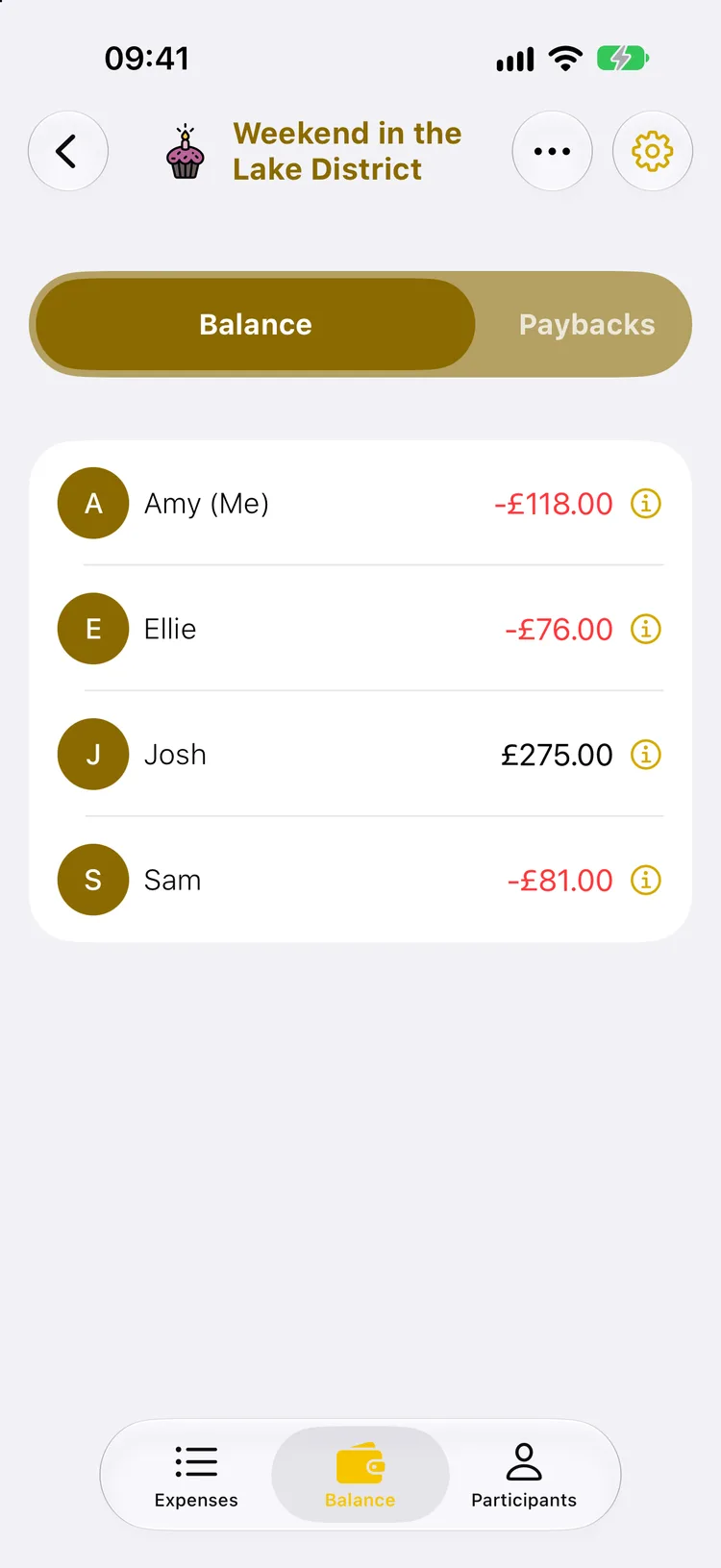
The weekend is over and the maths is done: Amy owes Josh £118, Ellie owes £76, Sam owes £81. All that is left is to send money to friends, and that is exactly where things stall. Ask for sort code and account number for a bank transfer, send a monzo.me link, use Revolut or PayPal, hand over cash? We make Banana Split, an expense-splitting app, and we looked at how 156,000 groups tracked in the app settle up. Here is what each way to pay a friend back costs in October 2026, its fees and limits, and the traps nobody reads.
The short answer. To send money to friends in the UK, a plain bank transfer is still the best tool: Faster Payments are free at most banks for personal accounts and usually land in seconds. A monzo.me link or a Revolut payment link saves typing account details, and PayPal is free to pay a friend in the simplest case. The fees start the moment a credit card, another currency or another country gets involved. In the euro area, Wero now does the same job with a phone number. Whatever you use, the real gain is elsewhere: cut the number of payments before you make a single one.
What groups actually do when they send money to friends
Paying back is the moment groups record least. Out of 156,748 groups with at least two people and five expenses, only 13.1% recorded even one payback in the app. For the other 87%, sending money to friends happened somewhere else, or never happened, and nobody ticked it off.
The groups that do record it are quick, and they finish the job.
- The median payback is €52. Half of all paybacks fall between €17 and €142, measured on groups kept entirely in euros.
- 86% record the first payback at most a week after the last expense, and 39% start before the end, during the trip itself.
- They settle a median 98% of what was owed. A group that starts paying back in the app almost always ends at zero.
In other words, the problem with sending money to friends is not the payment method. It is timing: paid back within the week, a tab closes; left for later, it never does. We wrote about the person stuck holding it in always the one who pays.
Ways to send money to friends, compared
| Method | What you need | Fees between friends | Typical limit |
|---|---|---|---|
| Bank transfer (Faster Payments) | Sort code and account number | Free at most UK banks | Set by your bank, often around £25,000 |
| monzo.me | A link or QR code | Free | Set by Monzo |
| Revolut | A Revolut account, or a payment link | Free between Revolut users | Depends on the currency |
| PayPal (friends and family) | An email address | Free in the same currency at home | Depends on the account |
| Venmo / Zelle (US) | A phone number or email | Free as standard | Set by Venmo or your bank |
| Wero (euro area) | A phone number or email | Free | Set by each bank, around €500 at several French banks |
| Cash | Notes | Free | None |
Fees and limits checked on official pages on 2 October 2026; each bank can set a lower limit when you send money to friends.
Sending money to friends in the UK: Faster Payments did the job all along
Paym, the old pay-by-phone-number service, closed in March 2023, so the UK has no single phone-number system any more. It hardly matters: Faster Payments have a scheme limit of £1 million since 2022, each bank sets its own lower personal limit, and a bank transfer to pay a friend is free and near-instant at almost every high-street bank. The friction is the account number, which is why links such as monzo.me took off: the friend taps the link and pays from any bank account.
Monzo also has a group tab, Monzo Split, which non-Monzo friends can join by link, though they still settle by bank transfer or cash. Revolut has Group Bills, where non-users settle by card. Both work well if your whole group banks there, and less well once one person does not.
Euro area: Wero and instant transfers
If you need to send money to friends in France, Germany, Belgium or Luxembourg, ask whether they have Wero, the payment system of European banks. It sends money by phone number or email, free, in seconds, and you can request money too, with the request valid for 30 days. Its weak point is the limit: around €500 per transfer or per day at several French banks.
Above that, use an ordinary transfer. Since 9 January 2025, under the EU Instant Payments Regulation, banks in the euro area may not charge more for an instant SEPA transfer than for a standard one, and since 9 October 2025 they must all be able to send one and must check the payee’s name before you confirm.
One group: pay friends back in three payments, not six
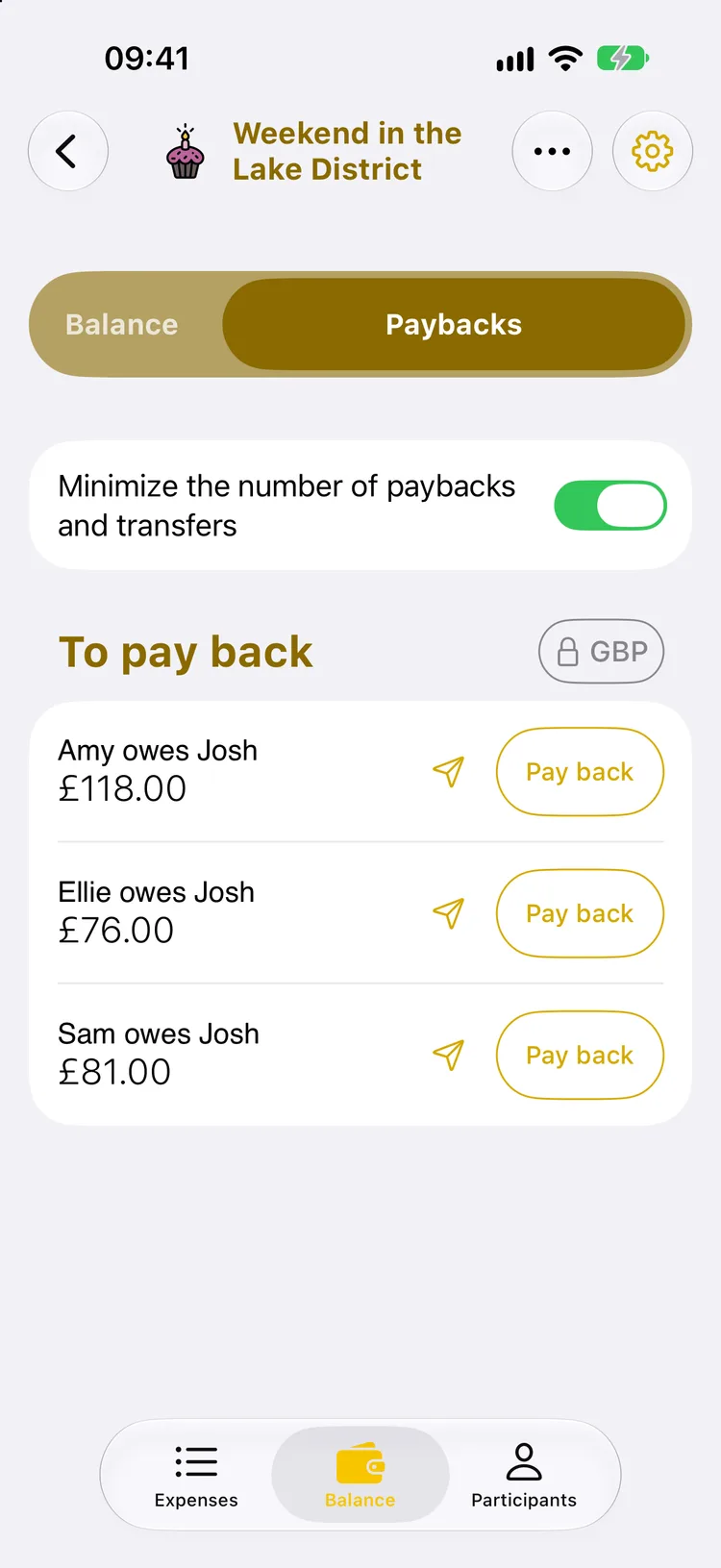
In a group of four where everyone paid for something, the instinct is to pay each person back for each expense. On our demo weekend, six expenses and four different payers, that could mean up to six crossed payments. Net the balances first and you need only three, all to Josh, who had paid for the cottage.
That is what the app works out: it starts from each person’s balance, what they paid minus what they used, and finds the smallest set of payments that brings everyone to zero. For four people, you never need more than three. Our guide to who owes what to whom shows the method, if you would rather do it by hand.
Traps to avoid when you send money to friends
The credit card inside a payment app. Sending money to friends is free from a balance or a bank account. Fund it by credit card and fees usually appear, typically around 3% on US apps such as Venmo and Cash App. Read the summary screen before you confirm.
Currency. If you pay a friend back in pounds when they paid in euros, PayPal takes 3% in conversion, on top of a rate the platform picks. Convert the debt once, at the day’s rate, and pay in the currency of the person receiving. We explain how in splitting expenses in several currencies.
The instant cash-out fee. On Venmo, the money is free to receive but 1.75% to move instantly to your bank. Standard transfers are free if you can wait.
Cash with no record. Handing over £80 at the next dinner works, until nobody remembers whether it happened. If you pay in cash, record it anyway.
Account details sent by message. One wrong digit and the money goes to a stranger. If your bank warns you that the name does not match, stop and check.
In groups tracked in the app, what share record at least one payback?
Out of 156,748 groups with at least two people and five expenses, 13.1% recorded at least one payback. Those groups settle a median 98% of what was owed.
How the app helps you pay friends back
The app does not move the money: it is not connected to any bank, by design. It handles everything around the moment you send money to friends.
- Calculate the paybacks. On the Balance tab, the Calculate paybacks button shows who owes what to whom, in as few payments as possible.
- Send the amount. On each line, the share button sends a message saying “Amy owes Josh: £118.00”, with a link to the app. Amy then only has to open her banking app.
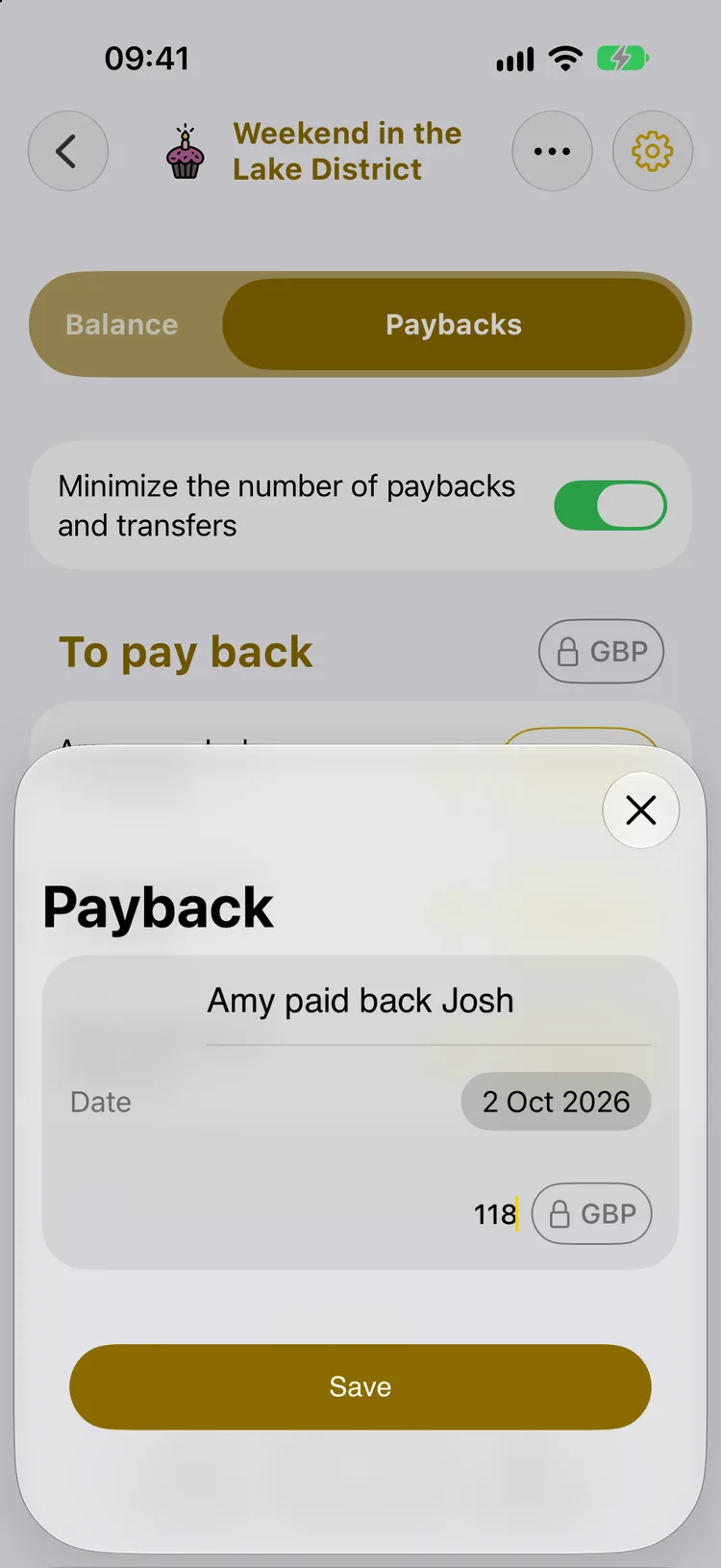
- Record the payback. Once the money is sent, the Pay back button records the payment on its date. The balance drops to zero and the line moves to the Paid back section, so nobody pays twice.
If an expense is added afterwards, the app flags it and offers to recalculate the paybacks.
What we would do
For a weekend with friends in the UK: a bank transfer or a monzo.me link for every share, and everyone pays back within 48 hours, while the trip is still fresh.
For an international group: everyone pays in the currency of the person receiving, by transfer, Wero or Revolut between users, and never by credit card inside a payment app.
Either way, do not pay back expense by expense. Let the app net the balances, make the three payments, and tick them off. Download Banana Split before the next trip.
Where the numbers come from
Our own data comes from the Banana Split database export of 24 September 2026: 156,748 active groups with at least two members and five expenses, paybacks excluded. A group “pays back in the app” if it holds at least one expense marked as a payback. The median amount is computed on the 34,361 paybacks recorded in euros; the timing compares the date of the first payback with that of the last expense; the share settled compares the total paid back with the sum of positive balances. The data is aggregated and anonymous. One limit we accept: a group that recorded nothing may have found another way to pay friends back, and we only measure what was recorded. Fees and limits come from the official pages of Pay.UK, Monzo, Revolut, PayPal, Venmo, Wero and the European Central Bank, checked on 2 October 2026.